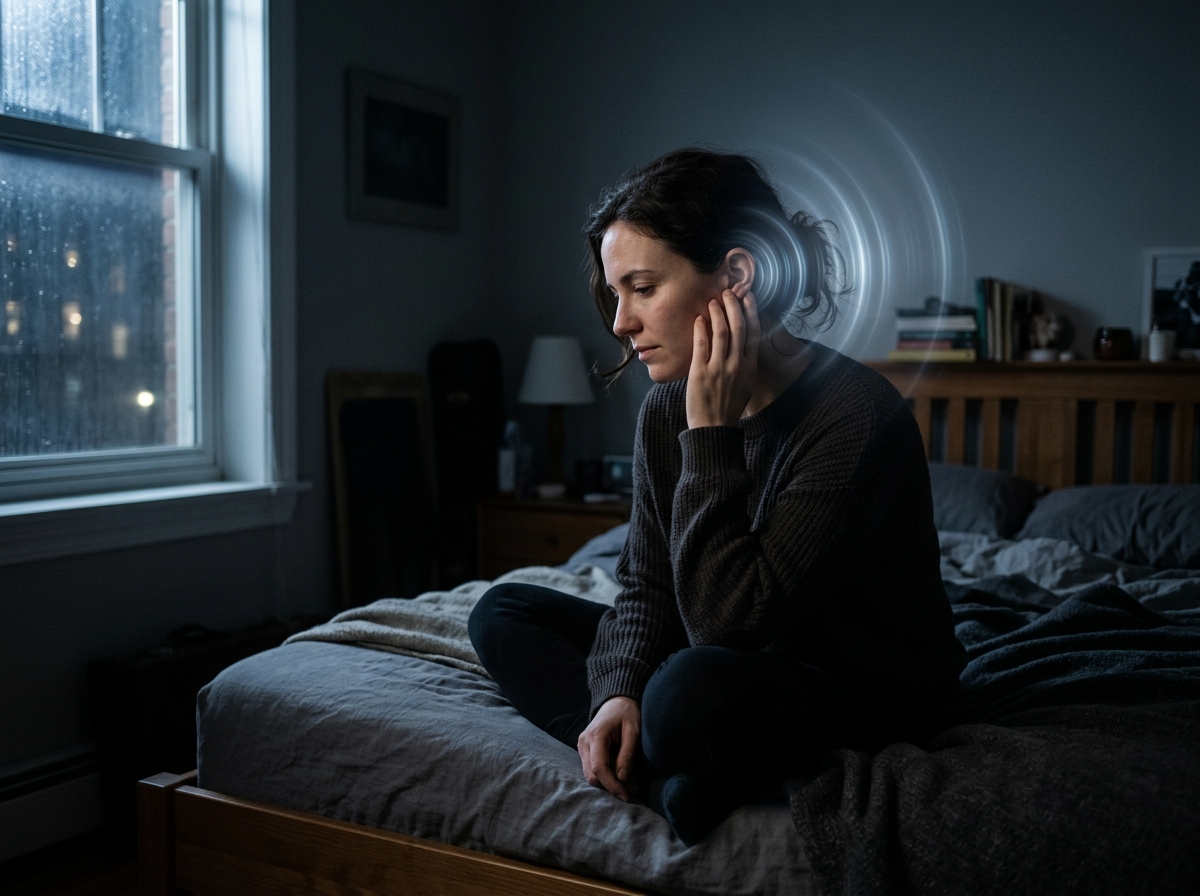
If you’ve been living with a persistent ringing, buzzing, or hissing in your ears, you’ve probably already Googled it at 2 a.m., wondering why it won’t just stop. You’re not alone — and you’re not imagining things. Tinnitus is one of the most searched health symptoms online, and interest in it has been climbing sharply for years. But most of what shows up in search results either oversimplifies the problem or tries to sell you something before explaining what’s actually going on. Here’s what the research says.
Tinnitus Isn’t a Disease — It’s a Signal
The first thing worth understanding is that tinnitus itself isn’t a condition — it’s a symptom. It’s your auditory system telling you that something, somewhere along the pathway from your ear to your brain, has changed. That’s why there’s no single “cure” for tinnitus the way there is for, say, a bacterial infection. The ringing can originate from damage to the tiny hair cells in your inner ear, from changes in blood flow, from nerve irritation, or — increasingly, according to recent research — from how your brain itself processes sound after hearing loss occurs.
This is a crucial distinction. Many people search for tinnitus expecting a straightforward fix, only to find endless products promising to “reverse” it. But according to researchers, the reality is more nuanced: tinnitus is generally something you learn to manage and reduce, not something you flip a switch to turn off.
Why Tinnitus Searches Have Spiked in Recent Years
Something interesting shows up in the data: online searches related to tinnitus, especially for one-sided (unilateral) ringing, have increased dramatically since the onset of COVID-19. Researchers who studied this pattern found that unilateral tinnitus searches rose more than threefold compared to pre-pandemic levels, and that overall interest in tinnitus as a topic — not just from patients but from people newly noticing symptoms — has trended upward since.
This lines up with a broader hypothesis in the audiology and otolaryngology community that viral illnesses, along with the stress, sleep disruption, and prolonged screen/headphone use that came with pandemic-era lifestyle changes, may have either triggered new cases or made existing tinnitus more noticeable to people already living with it.
What People Are Actually Asking About Tinnitus
When researchers analyzed hundreds of the most common tinnitus-related questions people type into search engines, clear patterns emerged. The single largest category of questions was about treatment — people want to know what actually works. Close behind that was interest in alternative treatment approaches, followed by questions about the technical or medical details behind the condition, and finally, questions about the timeline — how long tinnitus lasts and whether it gets worse over time.
Two more specific findings stand out. First, people searching about tinnitus were disproportionately interested in wearable sound-masking devices as a treatment option — not pills, not supplements, but devices that use background sound to make the ringing less noticeable. Second, when people tried to explain their own tinnitus to themselves, they most often attributed it to a neurological cause — something going on with the nerves or brain, rather than the ear itself.
This tells us something important: the public’s intuition about tinnitus — that it’s more about how the brain processes sound than a simple “broken ear” problem — actually lines up reasonably well with where current research has been heading.
The Winter Pattern Nobody Talks About
Here’s a detail that rarely gets mentioned outside of clinical journals: tinnitus search interest — and by extension, likely symptom severity or awareness — follows a clear seasonal pattern. Multiple long-term studies analyzing over a decade of search data found statistically significant winter peaks and summer troughs in tinnitus-related searches, consistently observed in the United States, Australia, Canada, and several European countries.
Researchers haven’t nailed down the exact biological mechanism, but they’ve floated a few plausible explanations: colder weather affecting blood flow and inner-ear circulation, seasonal changes in sleep patterns and stress levels, increased indoor time and screen/headphone use during winter months, and even the possibility that quieter winter environments simply make an existing ringing more noticeable when there’s less ambient noise to mask it.
Whatever the cause, if your tinnitus feels worse right now and it happens to be winter where you live, you’re not imagining a pattern — the data backs it up.
The Brain-Rewiring Theory
One of the more compelling explanations gaining traction in tinnitus research is the idea that tinnitus is, at least in many cases, a byproduct of the brain trying to compensate for hearing loss. When certain frequencies stop reaching the brain due to damaged hair cells, the auditory cortex doesn’t just go quiet in that frequency range — it appears to increase its own spontaneous activity there, essentially “turning up the gain” to compensate for the missing input. That phantom internal noise is what many researchers now believe tinnitus actually is: your brain filling a silence with static.
This theory helps explain a few things that used to be confusing. It explains why tinnitus often coexists with hearing loss, even hearing loss so mild that a person hasn’t consciously noticed it. It explains why stress and anxiety tend to make tinnitus louder — the brain’s stress-response systems and its auditory processing systems are more interconnected than previously understood. And it explains why approaches that focus on retraining the brain’s attention and response to the sound (rather than simply “curing” the ear) tend to have more durable results than people expect.
What Actually Helps, According to the Evidence
Given that tinnitus is now understood less as an ear problem and more as a brain-processing issue, the treatments with the strongest evidence behind them tend to focus on retraining or supporting that processing, rather than promising to eliminate the sound entirely.
Sound therapy and masking devices remain one of the most searched-for and clinically supported approaches. These don’t cure tinnitus, but they reduce the contrast between the ringing and silence, which for many people meaningfully reduces how intrusive it feels — especially at night.
Cognitive behavioral therapy (CBT) has some of the strongest clinical evidence of any tinnitus intervention, not because it changes the sound itself, but because it changes the brain’s emotional response to it, which is often what determines whether tinnitus feels unbearable or just mildly annoying.
Addressing underlying hearing loss — through hearing aids or auditory rehabilitation — has been shown to reduce tinnitus prominence in a meaningful subset of patients, particularly those whose tinnitus is linked to untreated high-frequency hearing loss.
Sleep, stress, and lifestyle management consistently show up in the research as modifiers of tinnitus severity, even though they’re not “cures.” Poor sleep and high stress don’t cause tinnitus, but they reliably make existing tinnitus louder and more distressing.
The Honest Bottom Line
If you’re searching for why your tinnitus won’t go away, the most evidence-backed answer is this: for most people, tinnitus isn’t something that simply disappears — it’s something the brain can learn to deprioritize over time, especially with the right combination of sound therapy, stress management, and addressing any underlying hearing loss. Anyone promising a fast, total reversal without addressing these underlying mechanisms is asking you to ignore what the actual research shows.
If your tinnitus is sudden, one-sided, or accompanied by hearing loss, dizziness, or pain, it’s worth getting evaluated by an audiologist or ENT rather than searching for a home remedy — sudden unilateral tinnitus in particular can sometimes signal something that benefits from early treatment.
This article is for informational purposes and isn’t a substitute for professional medical advice. If tinnitus is significantly affecting your quality of life, sleep, or mental health, consider speaking with an audiologist or your doctor.